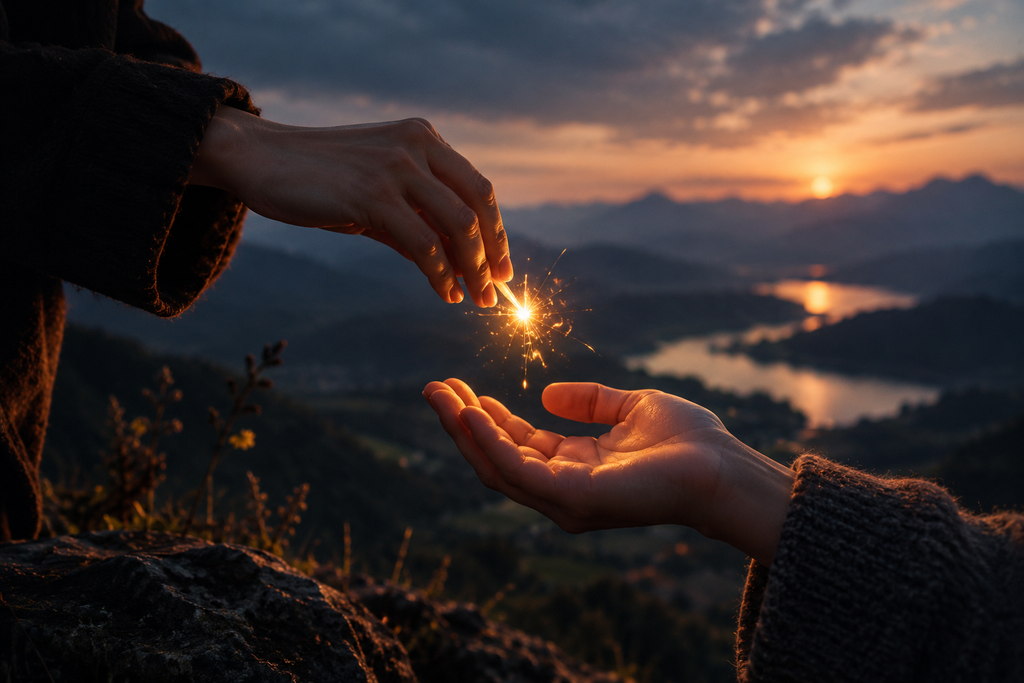
Sometimes, changing a person’s life doesn’t require something big.
A sentence.
An idea.
A look.
A question.
Even removing a small stone from someone’s path can become a spark.
Each of these can be a spark.
A spark may seem small. But you can never know in advance where it will land or what it will change.
You give someone an idea. They use it. Then that person touches the life of someone else. And that person affects another…
In this way, a small spark you once gave can travel much farther than you ever imagined.
This is the question Sparkism asks:
What does the spark we give to another person become in their life?
A spark does not always lead to a positive result.
Sometimes your advice helps someone move forward.
Sometimes it leads them to the wrong decision.
Sometimes it completely changes someone’s life.
And sometimes it becomes a difficult lesson they have to live through.
But there is an important distinction:
Are we responsible for every result that follows?
According to Sparkism, responsibility begins before the result: What did you give? Whom did you give it to? And how much of the possible consequence could you reasonably foresee?
For example, you give someone knowledge. They use it to develop themselves and later pass that knowledge on to someone else. Your spark no longer remains with just one person.
But if you intentionally give someone a means to cause harm, knowing what it will be used for, the matter is no longer simply about “giving a spark.”
Here, intention, knowledge, and the ability to foresee consequences matter.
So, what is development?
Sparkism does not see development simply as becoming “a better person.”
If someone learns something today that they did not know yesterday — they have developed.
If they make a mistake but learn from it — they have developed too.
Even a negative experience can become a form of development if it later helps a person make a better choice.
Because not every change in life looks beautiful or feels comfortable.
Sometimes a spark creates light.
Sometimes, it leaves a burn first.
The real question is:
What will you do with the spark you received?
And even more importantly:
What kind of spark will you leave behind?
Sparkism does not ask a person to change the entire world.
Perhaps it is much simpler than that.
Remove a stone from someone’s path.
Teach someone something they do not know.
Hold someone up when they are about to lose hope.
Do not “die” with the knowledge you carry—pass it on.
And sometimes, simply create a new question in someone’s mind.
Because sometimes a question is more powerful than an answer.
Perhaps the answer you are looking for lies within the question you have never asked.